
Lovebrook & Green
Luxury department store
About the
Project
No one had opened a new department store in the UK for a hundred years.
In a landscape crowded with underperforming sustainable marketplaces, Lovebrook & Green set out to do something that hadn't been attempted in over a century: launch a new national department store - digital-first, luxury-led, with sustainability as the baseline standard rather than the headline.
When the founder approached us, the existing model was a brand directory targeted at high net worth individuals. It had credibility and curation, but it wasn't generating meaningful revenue. Reliant on affiliate links, it was positioned as a curator, not a destination.
181st Street was brought in as the end-to-end strategy and delivery partner. Over a sixteen-month engagement, we worked from concept through to launch - designing, building, and bringing to life the UK's first new department store in over a century.
The Sunday Times called it "Liberty, with a strict door policy."
In a landscape crowded with underperforming sustainable marketplaces, Lovebrook & Green set out to do something that hadn't been attempted in over a century: launch a new national department store - digital-first, luxury-led, with sustainability as the baseline standard rather than the headline.
When the founder approached us, the existing model was a brand directory targeted at high net worth individuals. It had credibility and curation, but it wasn't generating meaningful revenue. Reliant on affiliate links, it was positioned as a curator, not a destination.
181st Street was brought in as the end-to-end strategy and delivery partner. Over a sixteen-month engagement, we worked from concept through to launch - designing, building, and bringing to life the UK's first new department store in over a century.
The Sunday Times called it "Liberty, with a strict door policy."
-
ClientLovebrook & Green
-
Year2024
-
RoleEnd-to-end strategic partners

Cult
Potential
The department store is one of the most successful retail formats in history.
None of the legacy players have translated that success online. Most have simply digitised their catalogues, moving inventory into ecommerce without reimagining the experience. The result is transactional, forgettable, and structurally incapable of building the emotional levers that make people come back: narrative, discovery, curation, belonging.
Sustainable marketplaces have the same problem, only worse. They lean on values-led messaging upfront - triggering what behavioural economists call the attitude-behaviour gap. Consumers say they want to shop ethically, but their purchase decisions are still driven by ease, desirability, and relevance. When sustainability becomes the sales pitch rather than the standard, the sale is lost before it begins.
Most sustainable marketplaces don't offer a full lifestyle assortment either. Limited product ranges mean limited cross-sell, limited upsell, and limited reasons to return. Average order value stays low. Customer lifetime value stays capped. The economics don't work.
The root problem is the same across all of them: these platforms are built around supply, not around behaviour. They focus on what's available rather than how people actually shop. Habits aren't formed through functionality - they're formed through emotionally engaging, frictionless experiences.
The cult potential was in the format. The department store model, done properly, creates the conditions for irreplaceability at the platform level: deep assortment enables cross-sell, editorial curation builds emotional attachment, and a coherent brand world makes the experience feel like a destination rather than a directory.
None of the legacy players have translated that success online. Most have simply digitised their catalogues, moving inventory into ecommerce without reimagining the experience. The result is transactional, forgettable, and structurally incapable of building the emotional levers that make people come back: narrative, discovery, curation, belonging.
Sustainable marketplaces have the same problem, only worse. They lean on values-led messaging upfront - triggering what behavioural economists call the attitude-behaviour gap. Consumers say they want to shop ethically, but their purchase decisions are still driven by ease, desirability, and relevance. When sustainability becomes the sales pitch rather than the standard, the sale is lost before it begins.
Most sustainable marketplaces don't offer a full lifestyle assortment either. Limited product ranges mean limited cross-sell, limited upsell, and limited reasons to return. Average order value stays low. Customer lifetime value stays capped. The economics don't work.
The root problem is the same across all of them: these platforms are built around supply, not around behaviour. They focus on what's available rather than how people actually shop. Habits aren't formed through functionality - they're formed through emotionally engaging, frictionless experiences.
The cult potential was in the format. The department store model, done properly, creates the conditions for irreplaceability at the platform level: deep assortment enables cross-sell, editorial curation builds emotional attachment, and a coherent brand world makes the experience feel like a destination rather than a directory.


01.
The identity gap
The founder believed her customers were all like her.
She was values-led, sustainability-conscious, passionate about ethical consumption. She assumed her audience was motivated by the same things, and that leading with those values would drive purchase.
She was half right. Her customers did share those values. But values weren't what was driving their purchasing behaviour.
This is the attitude-behaviour gap, and it's the single most common strategic error in purpose-led brands. If you ask customers why they buy from you, they'll tell you about the sustainability credentials, the mission, the values alignment. They'll mean every word of it. And almost none of it will be why they actually bought.
People don't buy because they've been convinced to care. They buy because something felt right - fast, intuitive, below the level of conscious justification. The ethics confirm the decision after the fact. They don't initiate it.
The customer Lovebrook & Green needed wasn't someone trying to become more ethical. She already is. She's affluent, considered, values-led, and time-poor. She has been making conscious choices for years - about food, travel, investment, philanthropy. She doesn't need a values education. She needs a shopping experience that assumes she has one, and saves her the effort of proving it to herself every time she makes a purchase.
She was values-led, sustainability-conscious, passionate about ethical consumption. She assumed her audience was motivated by the same things, and that leading with those values would drive purchase.
She was half right. Her customers did share those values. But values weren't what was driving their purchasing behaviour.
This is the attitude-behaviour gap, and it's the single most common strategic error in purpose-led brands. If you ask customers why they buy from you, they'll tell you about the sustainability credentials, the mission, the values alignment. They'll mean every word of it. And almost none of it will be why they actually bought.
People don't buy because they've been convinced to care. They buy because something felt right - fast, intuitive, below the level of conscious justification. The ethics confirm the decision after the fact. They don't initiate it.
The customer Lovebrook & Green needed wasn't someone trying to become more ethical. She already is. She's affluent, considered, values-led, and time-poor. She has been making conscious choices for years - about food, travel, investment, philanthropy. She doesn't need a values education. She needs a shopping experience that assumes she has one, and saves her the effort of proving it to herself every time she makes a purchase.


02.
The neo-tribe
Most sustainable ecommerce platforms orient toward millennials and Gen Z - purpose-led but price-sensitive, often priced out of premium sustainable products.
Using data from the Business of Fashion Luxury Brand Hierarchy, we modelled price thresholds and basket sizes to identify a core audience of AB1 women aged 55+, living in urban and commuter belt areas. This demographic controls over 50% of UK household wealth, makes 80–95% of household purchasing decisions, and is vastly underserved by modern retail - particularly in the ethical space.
They're brand loyal and digitally fluent. They value quality, provenance, and exceptional service. They expect a shopping experience that reflects their taste and respects their time. And they're almost completely ignored by the platforms that should be serving them.
Behaviourally, this audience is in a phase of identity reinforcement rather than identity exploration. At this life stage, identity is relatively stable, but consumption becomes a way of reaffirming values - a form of emotional homeostasis.
They don't want to be sold a better version of themselves. They want a brand that recognises who they already are.
We complemented this analysis with qualitative insights from user-generated content across competitor department stores. This revealed a valuable secondary segment: the "little luxuries" market - typically younger consumers purchasing high-end consumables as self-gifts or aspirational purchases. These served as brand entry points with strong potential for lifetime value growth.
Our behavioural profiling went deep: across each segment, we mapped psychographic traits, preferred media channels, conversion triggers, and loyalty drivers - creating a scalable targeting matrix for digital acquisition and CRM.
Using data from the Business of Fashion Luxury Brand Hierarchy, we modelled price thresholds and basket sizes to identify a core audience of AB1 women aged 55+, living in urban and commuter belt areas. This demographic controls over 50% of UK household wealth, makes 80–95% of household purchasing decisions, and is vastly underserved by modern retail - particularly in the ethical space.
They're brand loyal and digitally fluent. They value quality, provenance, and exceptional service. They expect a shopping experience that reflects their taste and respects their time. And they're almost completely ignored by the platforms that should be serving them.
Behaviourally, this audience is in a phase of identity reinforcement rather than identity exploration. At this life stage, identity is relatively stable, but consumption becomes a way of reaffirming values - a form of emotional homeostasis.
They don't want to be sold a better version of themselves. They want a brand that recognises who they already are.
We complemented this analysis with qualitative insights from user-generated content across competitor department stores. This revealed a valuable secondary segment: the "little luxuries" market - typically younger consumers purchasing high-end consumables as self-gifts or aspirational purchases. These served as brand entry points with strong potential for lifetime value growth.
Our behavioural profiling went deep: across each segment, we mapped psychographic traits, preferred media channels, conversion triggers, and loyalty drivers - creating a scalable targeting matrix for digital acquisition and CRM.

03.
The real enemy
The real enemy wasn't other department stores, Amazon, Net-a-Porter or the high street.
The real enemy was the sustainable marketplace itself - the category's own default model.
These platforms make shopping harder, not easier. They increase effort: more information to process, more justification to perform, more moral weight to carry through the purchase. They ask customers to think before they buy - in a context where thinking is precisely what slows behaviour.
Long lists of products with little categorisation. Weak UX. No brand continuity. Values-led messaging that triggers the attitude-behaviour gap before a customer even reaches a product page. Sustainability becomes the sales pitch, rather than the standard. And the sale is lost before it begins.
The enemy was friction disguised as values. To defeat it, we had to make choosing feel easier than evaluating. Sustainability couldn't be the headline - it had to be the baseline.
Every brand on the platform met strict ethical, regenerative, or circularity-based criteria. But the customer didn't need to do the work of verifying that. The curation had been done on her behalf. She could shop with confidence because the standard was already met - not because she'd been persuaded to care.
We conducted a full Green Claims Code audit to ensure compliance across every vendor, applying the same methodology we use across our FMCG client portfolio. The rigour was real. The customer just didn't need to see it upfront.
The real enemy was the sustainable marketplace itself - the category's own default model.
These platforms make shopping harder, not easier. They increase effort: more information to process, more justification to perform, more moral weight to carry through the purchase. They ask customers to think before they buy - in a context where thinking is precisely what slows behaviour.
Long lists of products with little categorisation. Weak UX. No brand continuity. Values-led messaging that triggers the attitude-behaviour gap before a customer even reaches a product page. Sustainability becomes the sales pitch, rather than the standard. And the sale is lost before it begins.
The enemy was friction disguised as values. To defeat it, we had to make choosing feel easier than evaluating. Sustainability couldn't be the headline - it had to be the baseline.
Every brand on the platform met strict ethical, regenerative, or circularity-based criteria. But the customer didn't need to do the work of verifying that. The curation had been done on her behalf. She could shop with confidence because the standard was already met - not because she'd been persuaded to care.
We conducted a full Green Claims Code audit to ensure compliance across every vendor, applying the same methodology we use across our FMCG client portfolio. The rigour was real. The customer just didn't need to see it upfront.



04.
The brand world
The brand world had to do three things simultaneously: signal luxury, embed sustainability without leading with it, and create a coherent emotional environment across hundreds of vendor brands.
In a multi-vendor platform, the parent brand has to function as the emotional and experiential throughline - the thing that makes each product feel like it belongs in the same world, even when it comes from a different maker.
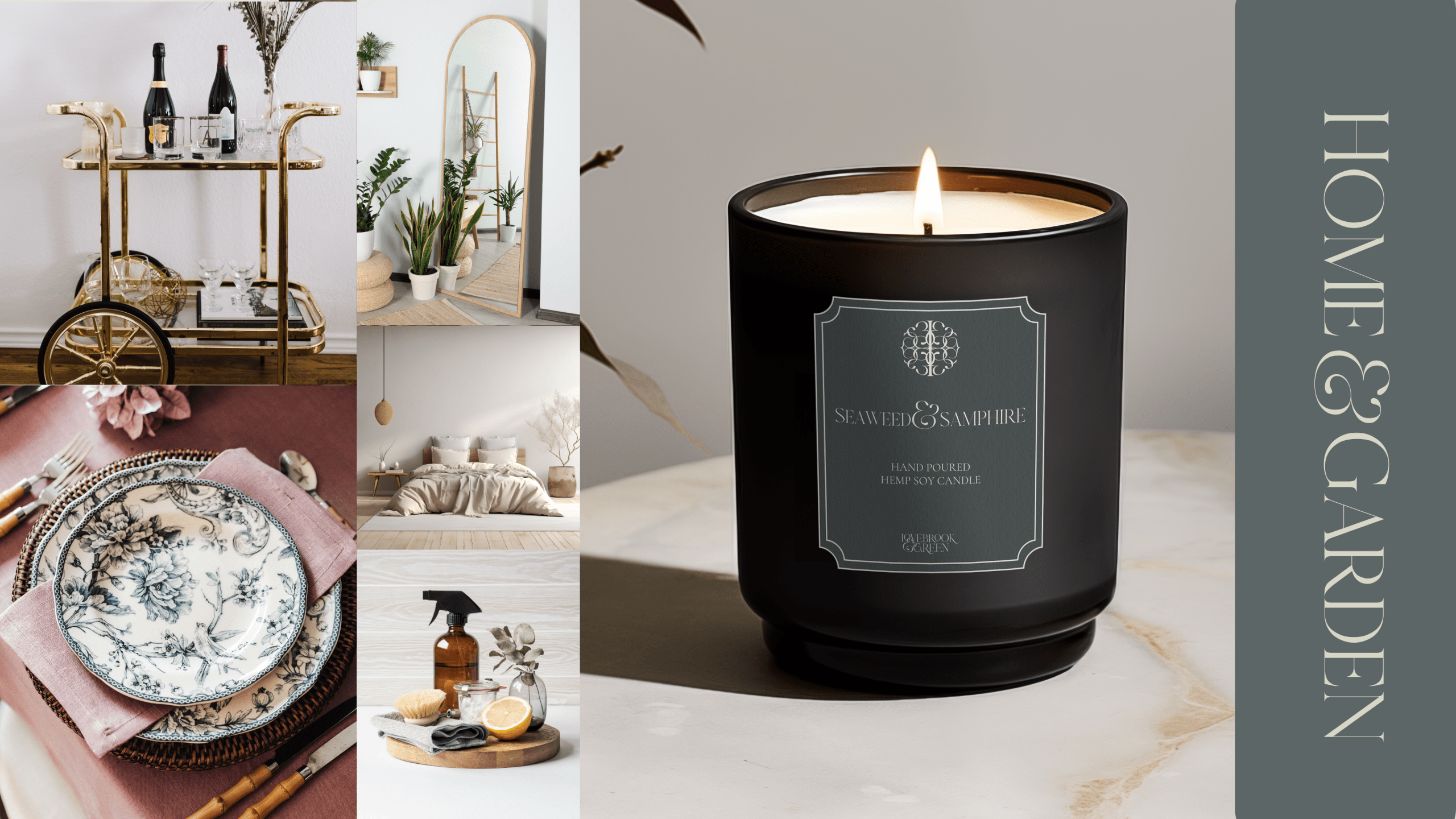
We created a refined, immersive brand world from logo system to typographic detail, designed to appeal to high-spending, values-led consumers without relying on the typical visual tropes of sustainability. No earnest green palettes. No kraft-paper humility. Understated luxury communicated through timeless visual cues.
Many of the platform's curated brands were selected for their regenerative principles and connection to nature, so we drew on these same ideas as the conceptual foundation. Inspired by the Gaia hypothesis and sacred geometry, we designed a full logo suite: a primary wordmark balancing heritage and restraint, a secondary monogram for shorthand applications, and an abstract mark rooted in the Seed of Life, mandala structures, and traditional filigree - signalling balance, interconnection, and quiet strength.
We developed an eighteen-colour palette spanning eight departments, inspired by British nature and heritage design. Typography and photographic direction were selected to reflect understated luxury - soft lighting, layered textures, slow editorial-style compositions that stand apart from the overly minimalist or trend-led visuals common in sustainability-first ecommerce.
The tone of voice was structured around three pillars: refined, warm, and purposeful. Elegant and considered, but never cold. Personable and welcoming, but never casual. Ethically grounded, but never preachy. This voice was crafted specifically to engage affluent women aged 55+ who respond to tone that acknowledges their discernment and reflects their values back to them without performing.
The UX strategy was informed by behavioural science and neuroscience-backed research into eye pattern trends and visual hierarchy.
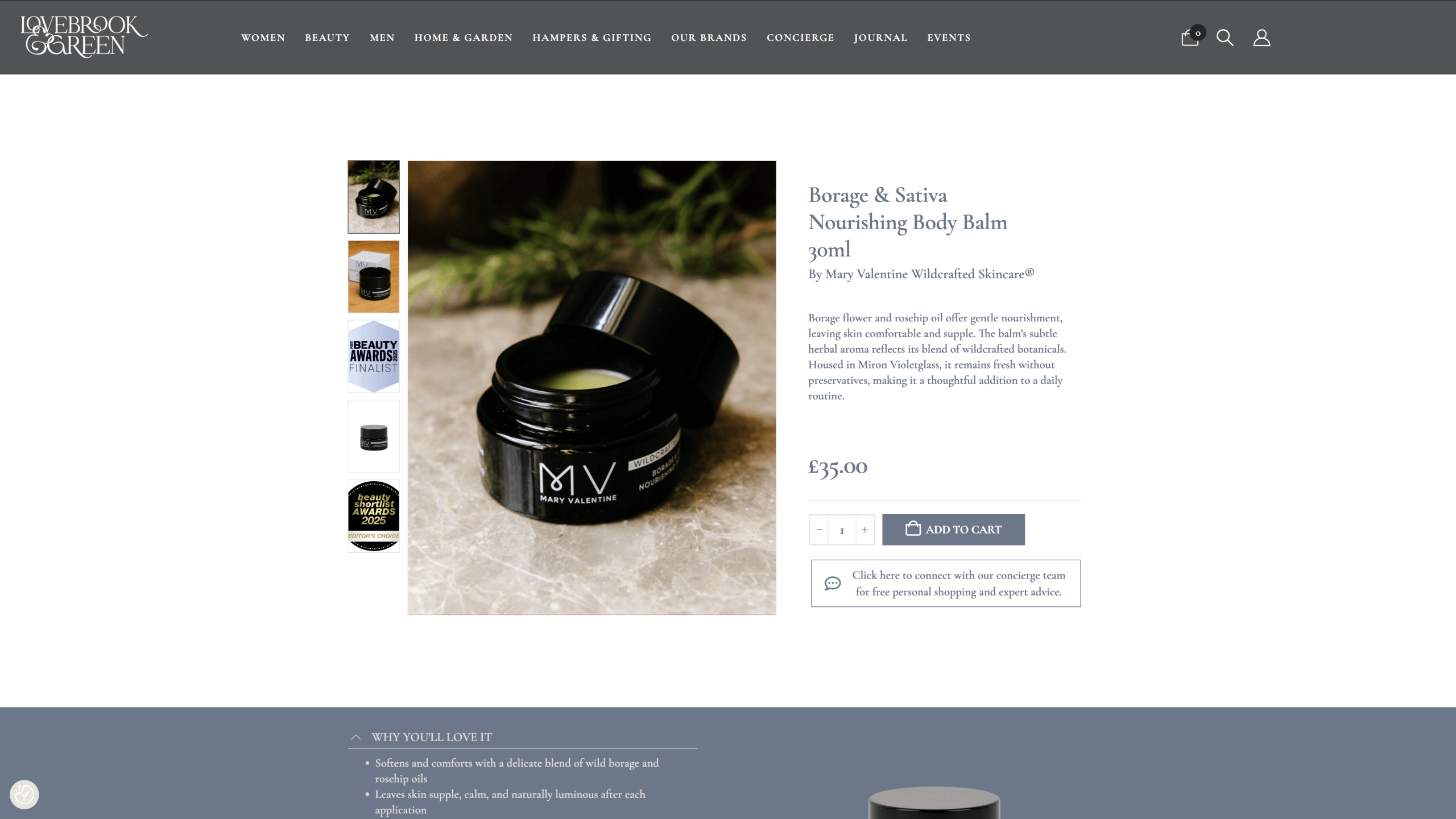
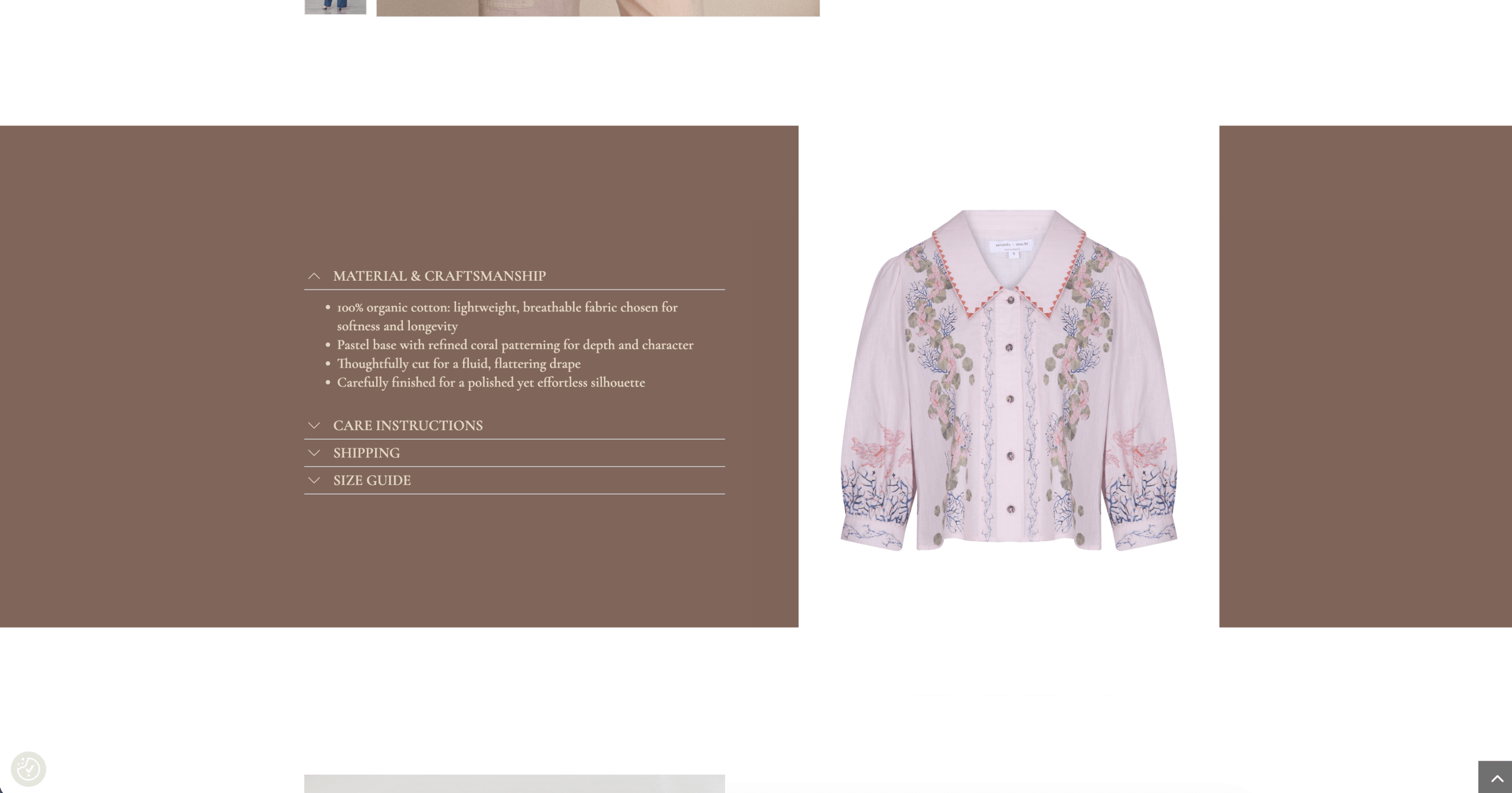
We rejected the standard grid-plus-blurb format in favour of long-form product pages that gave each product space to breathe and each brand room to tell its story. Each page was structured to guide users through emotional engagement to rational justification - anchoring desire before delivering detail. The goal was to replicate the editorial depth of a flagship department store within a fully digital environment.
We designed and wireframed the full site architecture, then built it in WordPress with a custom tech stack supporting multi-vendor dropshipping, automated order processing, and seamless fulfilment integrations with Shopify and WooCommerce.
The brand world worked behaviourally - reducing the cognitive load of shopping across hundreds of brands by making the entire experience feel curated, coherent, and trustworthy.
In a multi-vendor platform, the parent brand has to function as the emotional and experiential throughline - the thing that makes each product feel like it belongs in the same world, even when it comes from a different maker.
We created a refined, immersive brand world from logo system to typographic detail, designed to appeal to high-spending, values-led consumers without relying on the typical visual tropes of sustainability. No earnest green palettes. No kraft-paper humility. Understated luxury communicated through timeless visual cues.
Many of the platform's curated brands were selected for their regenerative principles and connection to nature, so we drew on these same ideas as the conceptual foundation. Inspired by the Gaia hypothesis and sacred geometry, we designed a full logo suite: a primary wordmark balancing heritage and restraint, a secondary monogram for shorthand applications, and an abstract mark rooted in the Seed of Life, mandala structures, and traditional filigree - signalling balance, interconnection, and quiet strength.
We developed an eighteen-colour palette spanning eight departments, inspired by British nature and heritage design. Typography and photographic direction were selected to reflect understated luxury - soft lighting, layered textures, slow editorial-style compositions that stand apart from the overly minimalist or trend-led visuals common in sustainability-first ecommerce.
The tone of voice was structured around three pillars: refined, warm, and purposeful. Elegant and considered, but never cold. Personable and welcoming, but never casual. Ethically grounded, but never preachy. This voice was crafted specifically to engage affluent women aged 55+ who respond to tone that acknowledges their discernment and reflects their values back to them without performing.
The UX strategy was informed by behavioural science and neuroscience-backed research into eye pattern trends and visual hierarchy.
We rejected the standard grid-plus-blurb format in favour of long-form product pages that gave each product space to breathe and each brand room to tell its story. Each page was structured to guide users through emotional engagement to rational justification - anchoring desire before delivering detail. The goal was to replicate the editorial depth of a flagship department store within a fully digital environment.
We designed and wireframed the full site architecture, then built it in WordPress with a custom tech stack supporting multi-vendor dropshipping, automated order processing, and seamless fulfilment integrations with Shopify and WooCommerce.
The brand world worked behaviourally - reducing the cognitive load of shopping across hundreds of brands by making the entire experience feel curated, coherent, and trustworthy.


Cult.
Activation
Without a paid ads budget, we designed a thirty-day pre-launch campaign built for emotional salience, not traffic spikes. Instead of features and offers, we shared poetic daily posts - each one crafted to prime a feeling and build anticipation before the first product was even revealed.
Then came the Private View: an invitation-only soft launch where we revealed one department at a time - fashion, home, beauty - pacing discovery like a gallery opening, not a sales drop. Every step was designed to build belonging before browsing, and resonance before revenue - ensuring that when customers finally saw the store, they already felt part of it.
We coached the founder through an intensive media and investor-readiness process, designed the investor pitch, and created a founder-focused LinkedIn video series. We produced detailed financial modelling, sales projections, and both a full pitch deck and SEIS pitch - securing SEIS approval in just 48 hours, the fastest on record for SeedLegals at the time. This led to an initial raise of £150,000.
Our team onboarded thousands of SKUs across lifestyle categories - auditing green claims, writing SEO-optimised brand profiles, rewriting product descriptions for tone and conversion, and conducting an extensive image audit for consistency and visual appeal at scale.
All pre-launch content and creative assets were developed by us, ensuring creative cohesion and agile execution throughout.
Then came the Private View: an invitation-only soft launch where we revealed one department at a time - fashion, home, beauty - pacing discovery like a gallery opening, not a sales drop. Every step was designed to build belonging before browsing, and resonance before revenue - ensuring that when customers finally saw the store, they already felt part of it.
We coached the founder through an intensive media and investor-readiness process, designed the investor pitch, and created a founder-focused LinkedIn video series. We produced detailed financial modelling, sales projections, and both a full pitch deck and SEIS pitch - securing SEIS approval in just 48 hours, the fastest on record for SeedLegals at the time. This led to an initial raise of £150,000.
Our team onboarded thousands of SKUs across lifestyle categories - auditing green claims, writing SEO-optimised brand profiles, rewriting product descriptions for tone and conversion, and conducting an extensive image audit for consistency and visual appeal at scale.
All pre-launch content and creative assets were developed by us, ensuring creative cohesion and agile execution throughout.